
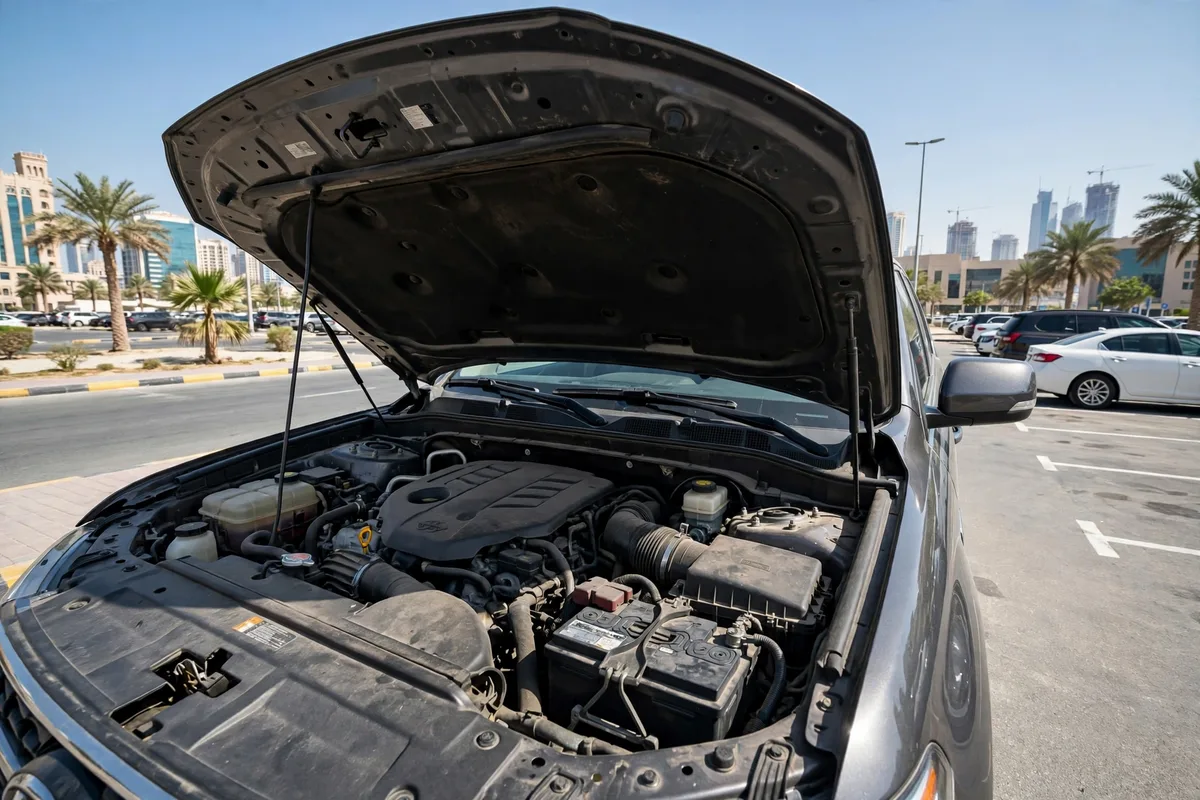
Why Does My Car Battery Keep Dying in Dubai Heat?
If your car battery keeps dying in Dubai heat, you are not alone. A car battery dying in Dubai heat rarely fails without warning. It usually gives small signs first, then one morning the car will not start. If you are asking why your car battery keeps dying in Dubai, the short answer is heat. Heat ages the battery from the inside, and short trips, a small drain while the car is parked, and a weak charging system finish the damage. Dubai Mobile Car Repair is based in Al Karama, and our mechanic comes to your home, office or parking to test the battery. Call 050 710 9412 | WhatsApp 054 445 9155 Hours: Saturday to Thursday, 8 AM to 10 PM. We are not an around-the-clock service. The short answer Heat is the first cause, but it is rarely the only cause. A battery in Dubai faces high temperatures every day of summer. The heat speeds up the chemical reactions inside the battery, dries out the electrolyte, and corrodes the internal grids. That is why your car battery keeps dying in Dubai even when the car still starts on most days. The battery loses capacity a little at a time, until one morning it cannot deliver the power the starter motor needs. Why heat is the first reason your car battery keeps dying in Dubai Most drivers blame the cold, because in a cold country a battery fails on a winter morning. In Dubai there is no cold morning to blame. The damage is done in summer, and the failure shows up later, often on a mild morning after the car stood in the sun. Dubai summer heat regularly climbs past 45 degrees. To understand why a car battery dies in Dubai, start with what heat does inside it. What heat does inside a battery A car battery stores power through a chemical reaction between lead plates and a liquid called the electrolyte. Heat speeds up that reaction, and that sounds helpful, but it is not. The faster reaction wears the battery out from the inside. What heat does What happens inside What you notice Electrolyte dries out Fluid evaporates and the plates dry Battery holds less charge Grid corrosion Internal grids corrode faster Capacity falls, cranking slows Sulfation Crystals harden on the plates Battery cannot deliver full power Self-discharge rises Battery loses charge while parked Car struggles after standing Case damage Case swells or cracks in heat Visible bulge, smell, leak When the fluid level drops, the exposed part of a plate sulfates and cannot hold a charge. When the grids corrode, the plates lose strength, so the battery cannot deliver enough current to crank the engine. All of this happens quietly, while the warm engine stays easy to start, so the battery can look healthy until the day it fails. Most cars use a flooded lead-acid battery, which holds loose liquid. Some cars, mainly cars with a start-stop system, need an AGM battery or an EFB battery. These types hold no loose liquid, so they lose less fluid in heat, but they still suffer corrosion and ageing. The battery must match the manufacturer’s specification for your car, including its cold cranking amps (CCA) and its reserve capacity (RC). Six reasons your battery keeps dying Heat is the first reason, but five more reasons decide how fast a weak battery dies. Most cars that keep dying have two of these reasons at once. 1. Heat damage Heat damage is the slow reason. It builds up over one hot summer after another, and it shows up as a battery that cranks a little slower each morning. A battery that has been through a few hot summers may still start the car on a warm afternoon, then fail on the first hard demand. Heat damage cannot be reversed by charging. A test shows how much life is left in the battery. 2. An old battery Every battery reaches the end of its life, and in Dubai heat that day comes sooner than in a cooler climate. An older battery holds less charge, so a small drain that a newer battery would survive is enough to flatten it overnight. The signs are a slow crank, dim lights at idle, and a car that needs a jump start more than once. A second jump start in a short time means there is an underlying fault, and replacing the battery without finding it only kills the new one too. 3. A parasitic drain A car battery drains overnight when a light, a module or an accessory keeps drawing power after you lock the car. A drain is a common reason why a car battery keeps dying in Dubai overnight, because the car looks fine during the day and is flat in the morning. Common causes are a glove box light that stays on, a dash camera wired to constant power, and a control module that never goes to sleep. A small draw is normal, because the clock, the alarm and the memory settings need power. 4. A failing alternator The alternator charges the battery while you drive, and it powers the lights, the AC and the electronics at the same time. If the alternator is failing, the battery must power everything on its own, and it drains a little more on each drive. The signs are a battery warning light that stays on, and a car that dies again while you drive. A new battery will not fix a failing alternator. It will only go flat again. 5. Corroded or loose terminals Even a strong battery can fail if the connections are weak. Corrosion on the battery terminals, a loose clamp, or a damaged cable stops the charge from reaching the battery, and stops the battery from delivering power to the starter. Look for a white, blue or green powder on the terminals, and a battery that shifts in its tray. A loose battery also vibrates as you drive, and vibration damages